Public transport in Albania is mostly furgons: shared minibuses that run between towns with no timetable and leave when they are full. They cost very little, they reach most towns, and the only real skill is knowing where and when to turn up, which you learn by asking a person rather than searching a website.
In short: a furgon is a shared minibus, the backbone of Albanian public transport. It runs between towns without a fixed timetable, leaves when it is full from a terminal or a known street corner, and you pay the driver in cash. Larger coaches run the main intercity routes out of Tirana on something closer to a schedule. Trains are not a practical option, and the reliable way to find today’s departure point is to ask at your accommodation the day before.
What is a furgon?
What you are actually looking for
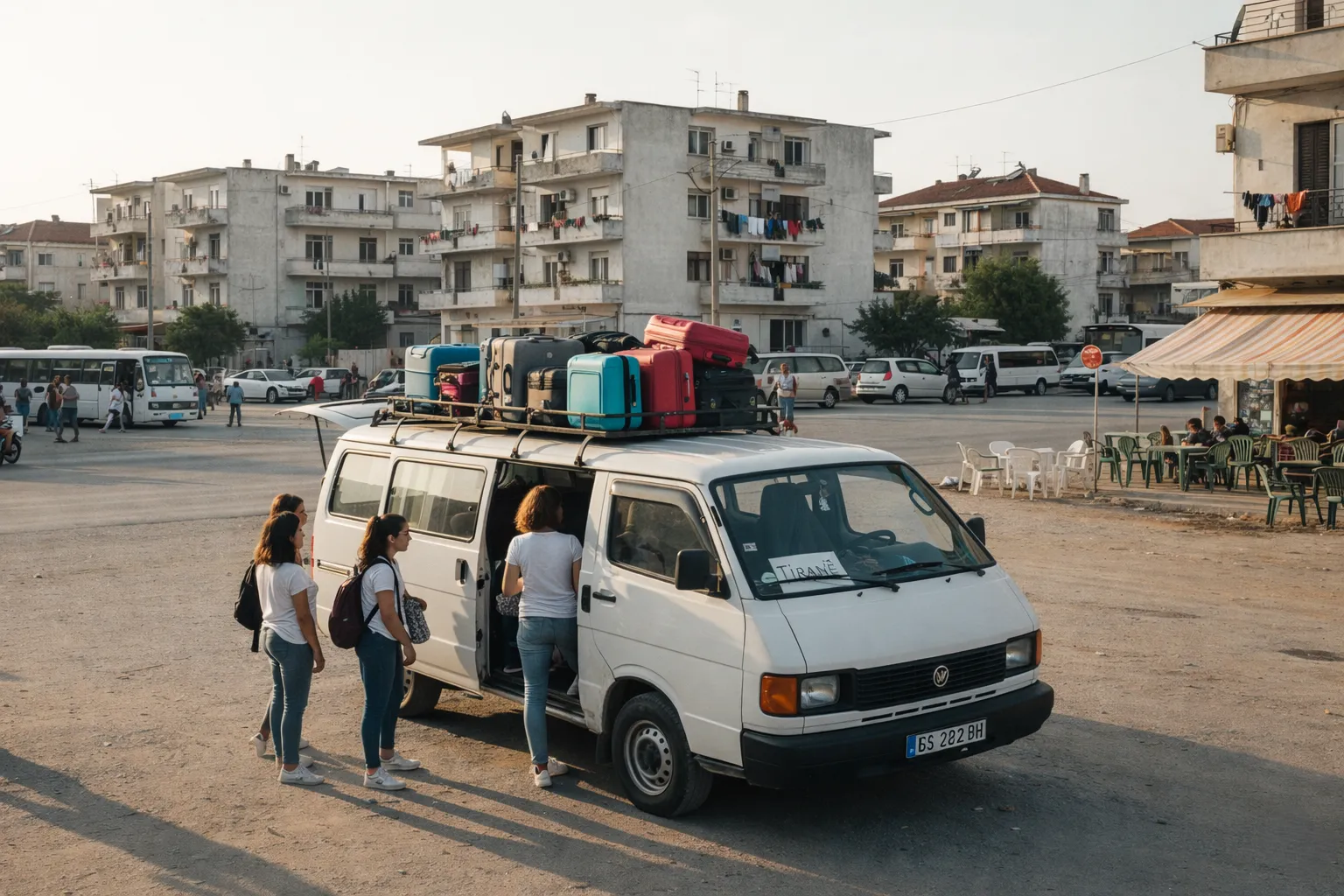
A furgon is a minibus, usually white, usually with a destination written in the windscreen. It works on a principle that visitors find either liberating or maddening: it leaves when it is full. There is no booking and no ticket. You find the right corner or terminal, tell the driver where you are going, get in, and at some point in the next forty minutes the last seat fills and you set off.
Why it leaves when full
The system is run by drivers rather than by a timetable, so departures follow demand. A busy route on a morning with plenty of passengers fills fast and goes quickly. A quiet route in the afternoon can sit for a long time. That is the trade-off for the price: you give up certainty and in return the network is cheap, flexible and reaches places a formal bus service would not bother with.
How Albania’s public transport system works
The five ways to move around
Furgons between towns, leaving when full, no timetable, cash on board.
Larger buses on the main intercity routes, closer to a schedule, more comfortable.
City buses in Tirana, cheap and crowded, with cash fares.
Taxis, plentiful and inexpensive, negotiated or metered depending on the town.
The railway, minimal and intermittent, and not a practical option.
What about trains?
A rebuilt Tirana to Durres line with a branch to Tirana airport is under construction, but in 2026 the government was still seeking an operator, with passenger trains planned for late 2027 at the earliest (Railway Gazette). Until that changes, treat rail as a curiosity rather than a way of reaching anywhere.
Ask, do not search, because the information does not live on the internet. Online timetables for Albanian buses and furgons are patchy, often out of date, and rarely list the actual street corner.
How to use a furgon, step by step
Before you go
Find the terminal or corner for your destination, which your accommodation will know.
Check the rough departure time with them too, and whether a larger bus runs the same route.
Ask what the fare should be, so you know what to expect when the driver asks for payment. Fares change, so treat any figure you hear as approximate.
On the day
Go in the morning, because departures thin out through the afternoon.
Tell the driver your destination before getting in, so the driver knows where to drop you and can confirm you are on the right vehicle.
Pay in cash, usually on arrival, and expect change.
Ask to be dropped anywhere along the route, which is normal and free.
Luggage goes on the roof or in the back, and comes with you.

Furgon, bus, taxi or car: which should you choose?
| Option | Best for | Downside |
|---|---|---|
| Furgon | Town to town on main routes, lowest cost | No timetable, waits until full, can be cramped and hot |
| Intercity bus | Longer journeys, more comfort, out of Tirana | Information is patchy and terminals move |
| Taxi | Sites away from towns, coves, early starts | Costs more; agree the fare or check the meter before setting off |
| Hire car | Beaches, villages, flexible days | Road conditions and parking need attention |
Who should go by furgon
Travellers on a town based trip, people with flexible days, and anybody who wants to spend very little. If you are happy to arrive at a corner, wait, and treat the wait as part of the day, the system suits you well.
Who should think again
Anybody with a fixed flight, a booked tour or a tight itinerary should add a buffer or use a taxi for the critical leg. Families with a lot of luggage may find a larger bus or a taxi less stressful. If your plan is beaches and hiking trailheads, a car or a mix of taxis will serve you better.
What works and what does not
Works: town to town, on the main routes, cheaply and frequently.
Works: getting to Berat, Gjirokaster, Saranda, Shkoder, Vlore and Durres.
Works: getting into the Alps in season, by shared van from Shkoder.
Does not work: reaching the beaches between the Riviera villages.
Does not work: archaeological sites away from towns, including Butrint without a taxi.
Does not work: tight schedules of any kind, because departures are not times.
Common mistakes to avoid
Planning from home. Searching for a timetable and building the day around it usually ends at an empty corner. Plan around a morning departure and confirm locally.
Arriving late. Afternoon services thin out sharply, and the last furgon on a quiet route may have gone already.
Not naming your destination. Say where you are going before boarding. Vehicles on the same corner head to different places.
Carrying only large notes. Drivers give change, but small notes make everything easier.
Booking something non-refundable straight after. A hotel check-in is fine; a timed ticket or a ferry departure is not, because journeys often take longer than the distance suggests.
Expecting a station at the other end. You may be dropped on a roadside or at the edge of town. Know the name of where you are staying and be ready to walk or take a short taxi.
Practical notes
Cash, always, in small notes.
Mornings for departures; afternoons thin out sharply.
Air conditioning is not guaranteed on a furgon in August.
Luggage on the roof is normal and generally safe.
Journey times are longer than the distance suggests, as they are by car.
Sunday service is reduced on many routes.
Where this fits in an Albania trip
Perfectly workable for a town based trip, and limiting for a beach or hiking one. A sensible carless plan is to base yourself in one town per region and use taxis or boats for the last stretch to anything that sits away from the road.
For the very first leg, from the airport into the city, and what each way of doing it costs, our guide to Tirana airport transfers covers the options.
For what the roads are like once you are on them, our guide to driving in Albania covers the conditions.
And for how cheap a carless trip here actually is, set against renting and driving, our Albania travel cost guide covers the numbers.

The short version
Use furgons, which are minibuses that leave when full, cost almost nothing and go everywhere between towns. Get the departure point and rough time from your accommodation the night before and confirm it in the morning, because no website has it. Travel in the morning. Carry cash in small notes. Forget the railway. And if you are travelling without a car, base yourself in one town per region rather than attempting day trips, which is what public transport here is bad at.
Have you tried getting around Albania by furgon, and what would you want to know before your first one?